How to Transfer an Out-of-State Driver’s License to Pennsylvania
Moving to Pennsylvania brings a practical question: how long can you keep driving with your old license, and what will you need to exchange it? For a valid out-of-state noncommercial license, PennDOT’s transfer process is an in-person visit, a vision screening, an application, and document checks. Planning those pieces ahead can help you avoid a wasted trip.
Who needs to transfer an out-of-state license
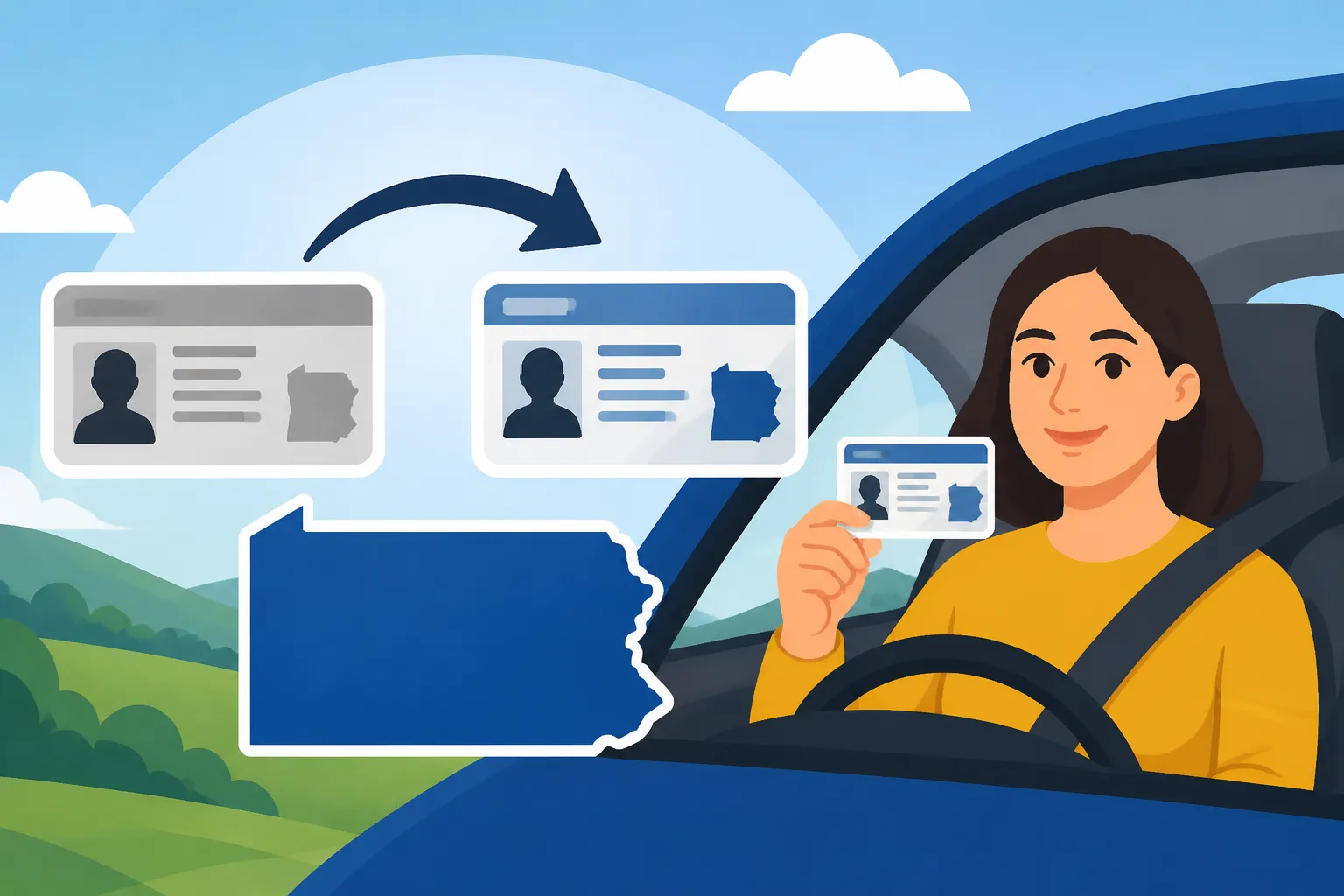
If you establish residency in Pennsylvania and hold a valid noncommercial driver’s license from another state, you must transfer it to a Pennsylvania license within 60 days, according to PennDOT. The transfer is handled in person at a PennDOT Driver License Center; it is not completed by simply changing your address or applying online.
The deadline makes it worth sorting out your license early in a move. Residency can begin before you have finished unpacking, updating every account, or registering other things in Pennsylvania. If you are unsure when PennDOT considers you to have established residency, ask PennDOT how the rule applies to your circumstances rather than choosing a convenient date yourself.
This transfer process is for noncommercial licenses. A commercial driver’s license, learner’s permit, or license that is expired or subject to a restriction may follow different requirements. Don’t assume the standard noncommercial process applies just because you previously held a driver’s license in another state.
For the standard transfer, PennDOT requires you to surrender your current out-of-state license, complete Form DL-180R, and pass a vision screening. PennDOT does not require a knowledge test for this transfer when you hold a valid out-of-state noncommercial license. That distinction is useful: you still need to prepare for an office visit and screening, but the standard transfer does not call for retaking the written knowledge test.
If your situation does not fit those conditions, check before making a trip. A prior suspension, an expired credential, a learner’s permit, a commercial license, or a name or identity-document issue could change what PennDOT asks you to do. The related articles Driving in Pennsylvania on Your Out-of-State License After Moving and Moving to Pennsylvania: Meeting the 60-Day License Window can help you think through timing while you confirm the details with PennDOT.
What to expect from the transfer
The core process is straightforward, but it helps to understand what each step accomplishes. You present your existing credential and supporting documents, complete the state application, and have your vision screened. PennDOT reviews the application and documents before issuing a Pennsylvania credential. The office visit is required, so online services cannot replace it for this transfer.
| Transfer step | What it means for you |
|---|---|
| Go in person | Visit a PennDOT Driver License Center for the transfer. |
| Surrender your current license | Bring the out-of-state license PennDOT requires you to give up. |
| Complete the application | PennDOT requires Form DL-180R for an out-of-state non-CDL transfer. |
| Pass a vision screening | Expect a vision screening as part of the process. |
| Present supporting documents | Bring identity and residency evidence that fits your situation. |
| Knowledge test | PennDOT does not require a knowledge test for a valid out-of-state noncommercial license transfer. |
According to PennDOT, a valid out-of-state noncommercial license must be transferred within 60 days after establishing Pennsylvania residency. The deadline and the in-person requirement are the two details to plan around first. After that, the most common source of avoidable delay is arriving without the right documents or with a form that is incomplete.
Surrendering the other state’s license is part of the exchange, not an optional extra. Don’t plan to keep both cards as active credentials. PennDOT requires applicants to surrender an out-of-state license that is valid or that falls within its applicable expired-license timeframe. Because the supplied rule does not specify that timeframe, confirm with PennDOT if your license has expired or if you are not sure whether you must turn it in.
If you want to review the surrender issue separately, see Surrendering Your Out-of-State License When Moving to Pennsylvania. If your prior credential is expired, the article Transferring an Expired Out-of-State License: When Testing Applies addresses the separate question of testing. In either case, use PennDOT’s instructions for your particular license status before relying on the standard process.
The transfer also does not mean every kind of credential is handled the same way. A permit is not the same as a full license, and a commercial license is not the same as a noncommercial one. If you held a permit rather than a full license, start with Transferring an Out-of-State Learner’s Permit to Pennsylvania. If you hold a CDL, use the Pennsylvania commercial licensing requirements rather than treating the standard noncommercial exchange as a substitute.
Documents to prepare before visiting
Document requirements depend on your circumstances, so use PennDOT’s current instructions as the final checklist. For a U.S. citizen who is at least 18 years old, PennDOT requires a Social Security card, one proof of identity, and two proofs of Pennsylvania residency for the standard transfer. Examples of residency evidence include a utility bill, lease, or W-2. PennDOT states that document requirements differ for non-U.S. citizens and for applicants seeking REAL ID.
The key is to organize documents by purpose. A document that establishes your identity may not establish your Pennsylvania residence, and a residence document may not meet the identity requirement. Don’t assume that one item will satisfy every category unless PennDOT specifically says it can.
Identity and Social Security documentation
Bring your Social Security card, as PennDOT requires it for the standard transfer described here. If you cannot locate it, or if the name on it differs from the name on your current license or identity documents, check PennDOT’s current instructions before your visit. A mismatch may require additional documentation, and guessing at what will be accepted can lead to a second trip.
For identity, PennDOT requires one proof. Confirm which documents qualify for your circumstances and make sure the details align across your records. If your legal name has changed, or if your current credential uses a different name than your supporting documents, review Updating Your Legal Name on a Pennsylvania Driver’s License and Required Documentation for a Pennsylvania Driver’s License Name Update. Those pages can help you identify the issue to resolve; PennDOT determines what documents it will accept for your transfer.
Proof of Pennsylvania residency
For a U.S. citizen age 18 or older, PennDOT requires two proofs of Pennsylvania residency. PennDOT gives a utility bill, lease, or W-2 as examples. The documents should support that you live in Pennsylvania, not merely show a connection to the state. Before you go, check that the items you plan to use meet PennDOT’s current requirements and reflect your relevant details accurately.
If you have recently moved and do not yet have common household records in your name, do not substitute documents based on assumption. Ask PennDOT what alternatives it accepts in your situation. The related article Identity and Residency Paperwork Needed for a Pennsylvania License may help you sort out the kinds of questions to ask, but the official agency’s current rules control.
Requirements that can differ
The standard document list above is not a universal list for every applicant. PennDOT says requirements differ for non-U.S. citizens and for REAL ID applications. If either applies to you, use the corresponding PennDOT instructions instead of treating the standard checklist as complete.
It also matters whether a document is original, a copy, or another form of record. Don’t assume a photo of a document on your phone will work as a substitute for the document PennDOT requests. Confirm the acceptable format in advance. If you are uncertain about a specific item, write down the document’s full name and ask PennDOT whether it meets the relevant requirement.
A useful preparation method is to place each document in a separate category before leaving home:
- Application: Form DL-180R, completed as instructed by PennDOT.
- Current credential: Your out-of-state license, which PennDOT requires you to surrender for the standard transfer.
- Social Security: Your Social Security card, as required by PennDOT for the standard transfer.
- Identity: One qualifying proof of identity for the standard U.S. citizen process described by PennDOT.
- Pennsylvania residency: Two qualifying proofs if you are a U.S. citizen age 18 or older, as PennDOT requires.
- Special circumstances: Any documents PennDOT identifies for non-U.S. citizens, REAL ID applicants, or applicants whose records do not match.
This is a planning aid, not a substitute for checking the official list. The safest approach is to compare every item you intend to bring against the PennDOT instructions that apply to you. If a document is ambiguous, resolve that question before traveling to the center.
How to complete the in-person transfer
The transfer requires an in-person visit to a PennDOT Driver License Center. Before you go, make sure the center handles driver licensing transactions and check its current services and hours with PennDOT’s official office locator. Locations can differ in the services they provide, so don’t rely on an old note, a search result, or an assumption that every PennDOT location processes the same work.
Before you leave
First, confirm that you are following the noncommercial transfer process and that your license status fits it. The standard steps apply to a valid out-of-state noncommercial license. If your credential is expired, a permit, a CDL, or otherwise subject to a special condition, check the applicable PennDOT requirements before you travel.
Next, complete Form DL-180R according to PennDOT’s instructions. PennDOT requires this form for an out-of-state non-CDL transfer. Read it carefully, provide the requested information, and resolve unclear answers before the visit if possible. An incomplete or inconsistent application can slow the transaction, particularly when names or other details do not match across documents.
Then assemble your supporting papers in a way that makes them easy to present. Keep the current license separate from your identity and residency evidence so that nothing gets left behind when you surrender the license. If you are applying for REAL ID, use that application’s document checklist too; the ordinary transfer list may not cover everything.
Finally, confirm the chosen center’s current services and hours with PennDOT’s office locator. For practical planning around offices and transactions, see PennDOT Office Visit Guide: Finding the Right Center in PA and Driver License Center vs Photo Center: Planning Your PA Visit. The locator and PennDOT’s current instructions should settle which location is appropriate for your transaction.
At the center
At the counter, explain that you are transferring a valid out-of-state noncommercial license to Pennsylvania. Present the application, your current license, and supporting documents as requested. PennDOT will review the paperwork and conduct the vision screening required for the transfer.
Follow the staff’s directions if a document needs clarification or the information on your application does not match your records. If the issue is a missing document or a different requirement for your status, ask what needs to be corrected and how to complete the transaction. Avoid guessing at a replacement document or changing an answer just to get through the visit.
PennDOT requires you to surrender your current out-of-state license as part of the standard exchange. That means you should be ready to hand it over during the transaction. If you are concerned about travel arrangements after surrendering it, ask PennDOT what credential or documentation you should expect before you leave the center. Do not assume that a temporary document, delivery method, or timeline applies unless PennDOT confirms it.
The vision screening is a required part of the process. If you use corrective lenses or have a vision-related concern, ask PennDOT what to expect and bring any information it tells you is needed. The screening requirement does not mean every applicant’s result or follow-up is the same, so take instructions from the agency if it identifies a need for additional steps.
A knowledge test is not required for the standard transfer of a valid out-of-state noncommercial license, according to PennDOT. That does not remove the application, document review, vision screening, or in-person visit. If your license is not valid or your case involves another credential type, confirm whether the standard no-knowledge-test rule applies to you.
After the transaction
Before leaving, make sure you understand what PennDOT has completed and whether anything remains outstanding. If the center gives you a document or directions about the next step, keep them with your important papers. If you do not understand a status, ask the staff to explain what action is still required and whether you should expect any further communication.
Do not make plans around a specific card-delivery date unless PennDOT gives you one. Processing and delivery details can vary, and the facts available here do not establish a delivery schedule. For related questions, How Long Until Your New Pennsylvania Driver’s License Arrives? covers delivery timing, while PennDOT Driver License Centers: What Staff Process at the Counter can help set expectations for an office transaction.
If you need to drive while the transfer is being completed, get a clear answer from PennDOT about what credential or documentation is valid for you during that period. Do not rely on an expired card, a receipt, or a temporary document unless PennDOT confirms that it authorizes you to drive.
Choosing whether to get REAL ID during the transfer
A Pennsylvania license transfer and a REAL ID request are related, but they are not identical decisions. You can ask about REAL ID while arranging your move, but the document requirements for REAL ID differ from the standard transfer requirements, according to PennDOT. That means the papers you gather for a regular license may not be enough for a REAL ID application.
Before deciding, consider whether you need a REAL ID for your own purposes and whether you can meet the separate documentation requirements. Avoid treating REAL ID as automatically included in every out-of-state transfer. Check PennDOT’s requirements and make sure you understand which credential you are requesting before you arrive.
If you plan to request REAL ID at the same time, review Getting a REAL ID When Transferring Your License to Pennsylvania and Required Documents for a Pennsylvania REAL ID. These pages can help you prepare, but PennDOT’s current list is the authority on what documents will be accepted.
A practical way to avoid confusion is to make two checklists: one for the license transfer and one for REAL ID. Mark each requirement against the correct application. If you meet the transfer requirements but do not have every REAL ID document, ask PennDOT whether you can complete the standard transfer first and address REAL ID separately. Do not assume the answer; the timing and available options depend on PennDOT’s rules.
REAL ID preparation also makes it especially important to check names and records. If your identity documents, residency evidence, or existing license use different information, resolve what you can before the visit. Bring the documents PennDOT says are needed for your specific application, not a general pile of papers that may omit a required item.
Situations that may change the process
The standard transfer is clear when you have a valid out-of-state noncommercial license and meet the document requirements. Other situations call for extra care. The point is not to assume that every complication makes a transfer impossible; it is to confirm which process applies before relying on the standard checklist.
Your out-of-state license has expired
The standard instructions described here concern a valid out-of-state noncommercial license. PennDOT also requires surrender of an out-of-state license that is valid or that falls within its applicable expired-license timeframe, but the timeframe itself is not specified in the information available here. If your license has expired, ask PennDOT whether it must be surrendered and whether you need additional steps or testing.
Do not assume that a recently expired license is treated exactly like a valid one, or that an older expired license is treated the same way as a permit. PennDOT’s determination depends on the status and history of the credential. The article Transferring an Expired Out-of-State License: When Testing Applies is relevant background, but confirm your own requirements with PennDOT.
You have a learner’s permit rather than a full license
A learner’s permit is not the same as a noncommercial driver’s license. The standard transfer steps and the no-knowledge-test statement described above should not be applied automatically to a permit. If you have an out-of-state learner’s permit, consult Transferring an Out-of-State Learner’s Permit to Pennsylvania and ask PennDOT what it requires for your permit and driving history.
This distinction matters for planning supervised practice and any future testing. Don’t begin driving under an assumption that your permit automatically carries over unchanged. Confirm whether Pennsylvania recognizes the credential and what restrictions or additional requirements apply.
You hold a commercial license
A CDL is outside the standard non-CDL transfer process. Commercial credentials have separate requirements, so use PennDOT’s commercial licensing guidance and do not rely on Form DL-180R as a complete solution for a CDL transfer. The article Guide to Commercial Driver’s License Requirements in Pennsylvania is a better starting point for identifying the right process.
Even if you also hold a noncommercial credential, be clear about which license you are transferring and what class you need in Pennsylvania. If you operate commercial vehicles, confirm the correct credential and any additional requirements with PennDOT before making a trip.
Your records do not match
Different names, dates, or other details across your license and supporting documents can make document review harder. A move, marriage, divorce, or earlier record correction may explain the difference, but the agency still needs acceptable documents to establish your identity and eligibility.
Compare the information on your current license, Social Security card, identity evidence, and residency documents before visiting. If something differs, ask PennDOT what evidence will resolve the mismatch. For a legal name change, see Updating Your Legal Name on a Pennsylvania Driver’s License. If the issue concerns documentation more broadly, Identity and Residency Paperwork Needed for a Pennsylvania License may help you organize the question.
Your license has a restriction or other complication
A medical restriction, prior suspension, or other condition may require a different review from a routine exchange. Do not assume that the transfer will clear a restriction or restore a driving privilege. Before driving or applying, check your status and ask PennDOT how the condition affects your case.
If the concern is a medical condition, How Pennsylvania Evaluates Medical Conditions and Driving Safety provides relevant context. If your license has been suspended or your driving privilege is not active, use the applicable restoration information and confirm your current status with PennDOT instead of proceeding as though you hold an ordinary valid license.
Common mistakes and a practical checklist
Many transfer problems are preventable. They usually come from treating the visit as a simple card swap, using the wrong process for the credential, or relying on documents that do not satisfy PennDOT’s current requirements.
Mistakes to avoid
- Waiting until the move feels settled. PennDOT gives new residents a 60-day transfer period for a valid out-of-state noncommercial license. Put the license transfer on your moving checklist rather than leaving it until the end.
- Assuming an online transaction is enough. The standard transfer requires an in-person visit to a PennDOT Driver License Center.
- Bringing only the out-of-state license. PennDOT also requires Form DL-180R, a vision screening, and supporting documents.
- Expecting to keep the old license. PennDOT requires surrender of the current out-of-state license for the standard transfer.
- Assuming the knowledge test is part of the visit. PennDOT does not require a knowledge test for the transfer of a valid out-of-state noncommercial license. If your credential is expired or a different type, verify which requirements apply.
- Using the standard checklist for every applicant. PennDOT says requirements differ for non-U.S. citizens and REAL ID applications.
- Going to a location without checking its services. Confirm with PennDOT’s official locator that the selected center handles the transaction and check its current hours.
- Guessing about an expired license. Ask PennDOT whether the credential must be surrendered and whether additional requirements apply.
- Assuming a temporary paper or receipt permits driving. Confirm directly with PennDOT what you may use while any remaining steps are pending.
A pre-visit checklist
Use this checklist as a starting point, then compare it with PennDOT’s official instructions for your situation:
- Confirm that you have a valid out-of-state noncommercial license, or identify the reason your case differs.
- Note when you established Pennsylvania residency so you can manage the transfer deadline.
- Complete Form DL-180R according to PennDOT’s instructions.
- Bring your current out-of-state license, ready to surrender.
- Bring your Social Security card if you are following the standard document requirements.
- Bring one proof of identity and, if you are a U.S. citizen age 18 or older, two proofs of Pennsylvania residency, as PennDOT requires.
- Check any additional document requirements that apply to non-U.S. citizens or REAL ID applicants.
- Confirm the selected PennDOT Driver License Center’s services and current hours using the official office locator.
- Plan to complete the required vision screening at the center.
- Ask PennDOT about any expired status, restriction, record mismatch, or question about driving while the transfer is pending.
The checklist is deliberately cautious: it helps you get organized but cannot decide whether a particular document or unusual circumstance qualifies. If you have a doubt, settle it with PennDOT before going. A short confirmation can prevent a trip that ends with a request to return with different paperwork.
Frequently Asked Questions
Do I have to transfer my valid out-of-state license in person?
Yes. PennDOT requires new residents transferring a valid out-of-state noncommercial license to go in person to a PennDOT Driver License Center.
Is there a knowledge test for the standard transfer?
PennDOT does not require a knowledge test when you transfer a valid out-of-state noncommercial license. You still need to complete the application, pass the vision screening, surrender your current license, and present the required documents.
What documents should I bring?
For the standard process, PennDOT requires your Social Security card and one proof of identity. If you are a U.S. citizen age 18 or older, PennDOT also requires two proofs of Pennsylvania residency; examples include a utility bill, lease, or W-2. Requirements differ for non-U.S. citizens and REAL ID applications.
What if my out-of-state license is expired?
The standard transfer described here applies to a valid license. Ask PennDOT whether your expired license must be surrendered and whether your case requires other steps. Do not assume the valid-license process applies.
Can I get REAL ID during the transfer?
You can ask PennDOT about REAL ID, but its document requirements differ from those for a standard transfer. Check the REAL ID checklist before your visit so you know which credential you are requesting and what evidence to bring.
Sources
- PennDOT — Moving to Pennsylvania | Driver and Vehicle Services | Commonwealth of Pennsylvania (checked November 11, 2026)
Disclaimer
This article is for general informational purposes only and does not constitute professional advice. Laws, prices and regulations vary by location and change over time. Consult a qualified professional for guidance on your specific situation. Pennsylvania Driver Guide is not a government agency and is not affiliated with any state motor vehicle department.